Two Pence, Infinite Regret: The Off-Season Seaside Arcade as a Glowing Stage Set
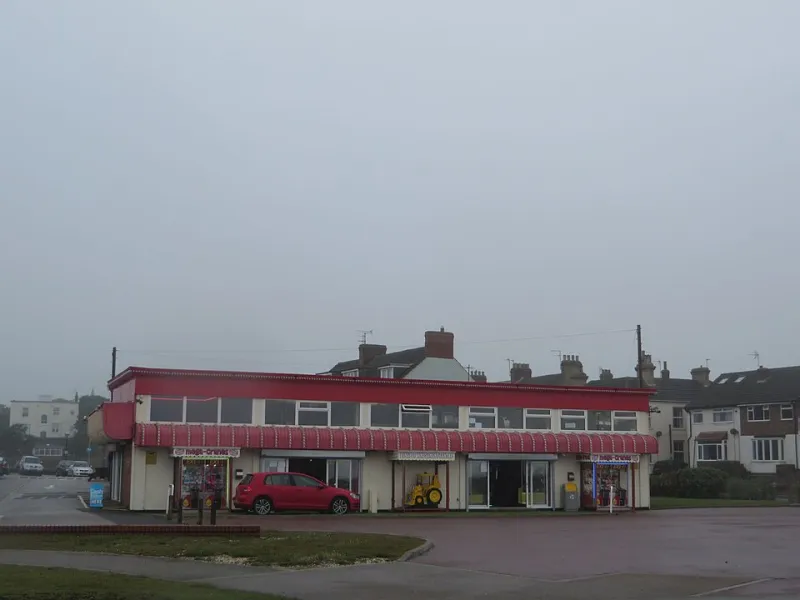
Photo: Graham Robson , CC BY-SA 2.0, via Wikimedia Commons
The last coach leaves at about half past five. You can tell because the promenade suddenly gets wider, the chip shops start stacking chairs and the seagulls switch from optimistic to openly threatening. This is the off-season seaside, and it has a secret. The arcade is still open.
Inside, the light is a different weather. Pink, blue, amber and a green that exists nowhere in nature bounce off the carpet and the glass and the faces of the few people still feeding coins into machines. Outside, the prom is wet and grey. Inside, it is a stage set waiting for a performance that has already happened. The 2p machines do not care. They are always on.
The Last Coach Has Left the Prom
The British seaside arcade is a peculiar institution. It is a gambling hall for people who do not consider themselves gamblers, a funfair for people who dislike rides, and a museum of mechanical optimism. In summer it is noise and elbows. In winter it is something better: a lit box by the sea, humming to itself.
The off-season arcade is a place of deep quiet punctuated by electronic chirps and the occasional cascade of copper. The carpet is patterned like a migraine. The air smells of hot dust and sugar. A member of staff appears from behind a change machine, looks at you with the calm of someone who has seen every possible way a human can lose two pence, and disappears again.
The 2p Machine Is a Tiny Theatre
The penny fall is the heart of the operation. You drop a coin through a slot. It lands on a moving shelf of other coins. Nothing happens. You drop another. A small avalanche begins, then stops. A single 2p coin teeters on the edge. You watch it with the intensity of a hawk. It falls. You win four pence and a feeling of enormous, disproportionate triumph.
The machine is a drama in three acts: hope, delay, anticlimax. It is also a brilliant piece of design. The lights, the mirrors, the little sweeps of metal that push coins towards the edge: all of it exists to make you believe the next coin will change everything. It will not. But for a few seconds, you are a person with a strategy.
Off-season, the players are different. A pensioner with a plastic cup of coins works the same machine with the patience of a gardener. A teenager films a win for people who are not there. A couple in waterproofs argue gently about whether the machine is rigged. It is. That is not the point. The point is the shared language of the ledge.
Clairvoyant Cabinets and Other Liars
Further back, the arcade gets stranger. There is a fortune teller cabinet with a mannequin head and a light behind its eyes. It will tell you your future for 50p, but first it will take its time. The head turns. The eyes glow. A card appears. The card says something vague about a journey. You have just paid for a machine to be mysterious at you, and somehow it works.
Then there are the grabber machines, full of plush toys that look like they have been through customs. The dancing game nobody plays. The racing game with a steering wheel that has lost its centre. The coin pusher that is really just a penny fall with a bigger cabinet and a worse attitude. These machines are not modern. They are not retro in a curated way. They are simply still here, which is its own kind of magic.
Shooting Neon on Wet Tarmac
The off-season arcade is a gift for photographers, but it asks for restraint. Do not try to capture the whole room at once. The whole room is too much. Find a corner. Find a reflection. Find the gap between the machine and the window where the neon leaks out onto the prom.
Outside, wet tarmac is your friend. It doubles the lights, smears them into colour and turns a puddle into a second composition. Wait for a break in the rain. Use a wide aperture if you have one, or brace your phone against a rail. The arcade window itself is a useful filter: condensation, fingerprints and old stickers all add texture. Ask before photographing staff or players. Most people are kind about it, but nobody wants to be the accidental subject of a moody seaside essay.
Inside, look for the small dramas. A hand dropping a coin. The reflection of a machine in a pair of glasses. The single unlit bulb in a row of otherwise frantic lights. The arcade is a low-light environment, which means noise, grain and a certain honesty. Embrace it. The pictures are not meant to look like adverts. They are meant to look like the place felt.
The Peculiar Dignity of Winter Arcades
There is a lazy way to write about the British seaside out of season: sad, empty, forgotten, end-of-the-pier. The arcade refuses that. It is not sad. It is between performances. The lights are on, the coins are stacked, the fortune teller is still lying. Someone will come in, shake the rain off their coat and spend ten minutes trying to win a keyring worth less than the bus fare home.
That is the dignity of the place. It does not need a crowd to be itself. It just needs a socket and a few people willing to believe that the next coin will tip the balance. Owl’s Pics recommends the off-season visit. Go late. Take a camera. Bring two pounds in coppers. Lose most of it, win a little, and step back out onto the wet prom while the neon is still glowing behind you.