Above the Doner: The Peeling Painted Ads Still Haggling Over Britain’s High Streets
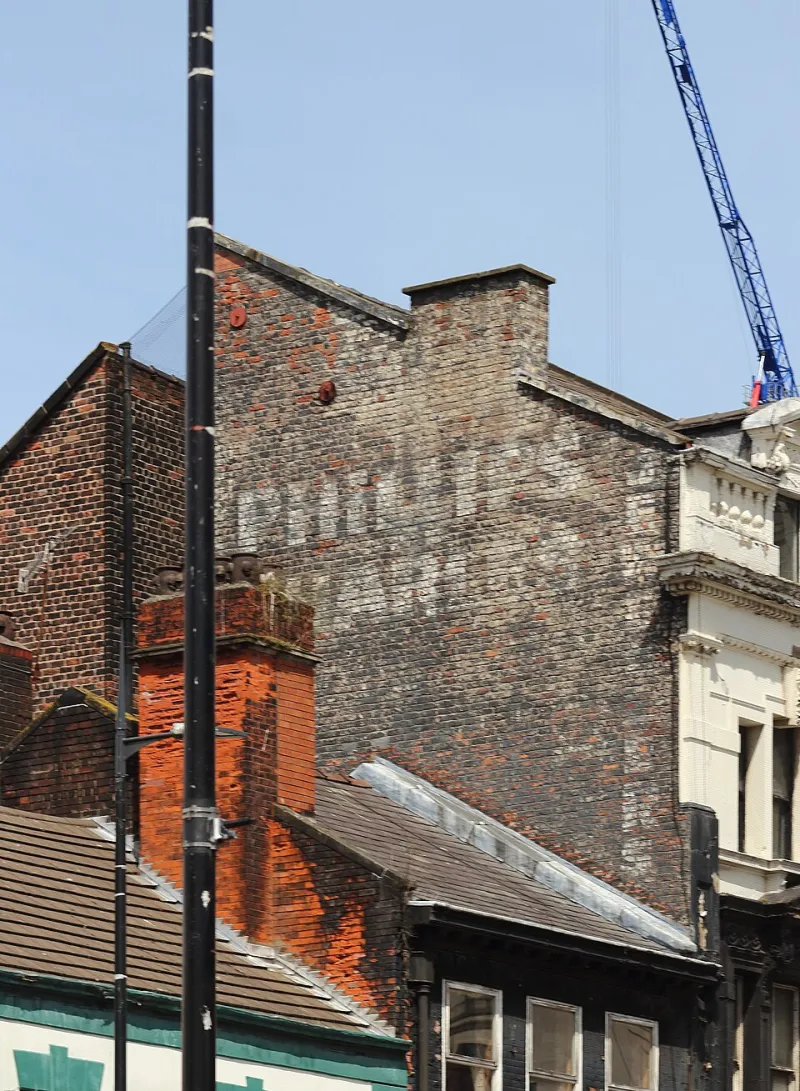
Photo: Rodhullandemu, CC BY-SA 4.0, via Wikimedia Commons
The modern high street asks you to look straight ahead. It wants you to see the illuminated menu, the laminated offer, the QR code that promises a free can of drink if you surrender your email address. The older high street asks you to look up. There, above the takeaway, a different conversation is still happening in peeling paint. It is slower, stranger and much more beautiful.
Ghost signs are the faded remains of hand-painted advertisements on brick. You find them above chip shops, kebab houses, bakeries, betting shops and charity shops that used to be something else entirely. They advertise ales, cycles, grocers, teas, sauces and businesses that no longer exist. Some are almost invisible. Some are so clear you can still read the slogan and feel mildly guilty about not buying whatever it was.
The Wall Remembers First
A high street is a layer cake of commerce. The current tenant gets the glass frontage and the bright plastic signage. The building keeps the rest. Look above the doner spit and you may find the ghost of a grocer’s sign in cream and black, or a faded promise about celebrated ales, or the word BAKERY in letters that have outlived every loaf it ever sold.
These signs are not designed to be art. That is precisely why they work. They were practical, loud and commercial. They wanted your attention and your money. Now they want nothing. They just sit there, letting the weather edit them. Rain takes a letter. Soot softens the edges. A later extension cuts off the final word. The result is a kind of accidental poetry, usually advertising something you cannot buy and would not want if you could.
A Brief History of Shouting on Brick
Before vinyl wraps and LED menus, signwriters climbed ladders and painted directly onto buildings. The best of them were typographers with steady hands and a head for heights. They worked in an age when a wall was a billboard and a shopfront was a small act of civic pride. Some of the lettering still has a confidence that modern signage lacks: fat serifs, swooping scripts, shadows painted in by hand to make a flat wall feel three-dimensional.
The signs survived because brick is stubborn. Paint fades, but it does not always vanish. Repointing, rendering, extensions and decades of grime can bury a sign or preserve it in fragments. A ghost sign is not a photograph of the past. It is a negotiation between the past and the present, with the weather acting as editor.
The Poetry of Half a Name
There is a special pleasure in a business name that has been reduced to three letters and a smudge. You find yourself completing it wrongly. Was it H. Wilkinson and Sons? Was it a brewery? Was it a shop that sold something useful and slightly depressing, like mangle parts? The uncertainty is the point. A ghost sign is a short story with the ending scraped off.
Above takeaways, the effect is especially good. The modern shop is selling heat, salt and late-night decisions. The old sign is selling something more sedate: tea, bread, insurance, bicycles. The two layers argue quietly across the decades. Below, a fluorescent menu board shouts about garlic sauce. Above, a ghost sign whispers about family grocers. Both are trying to get you to come in. Only one still has a door.
Shooting the Upper Storey
This is a photographic genre that rewards neck ache and patience. Start by looking up. Really up. Most of us walk high streets at eye level, which means we miss half the architecture and nearly all the accidental art. A ghost sign often reveals itself only when you step back, cross the road and squint through a bus shelter.
Use a longer lens to compress the sign against the brick and isolate the lettering. Overcast days are ideal, because flat light lets the faded contrast do the work. If the sign sits above a bright takeaway, come back at dusk. The modern neon below and the old paint above can make a wonderfully odd double portrait of appetite. Watch for reflections in windows, too. A ghost sign reflected in a kebab shop pane looks like a memory trying to get back inside.
Do not trespass, do not climb unstable walls and do not ask a shopkeeper to move a extractor fan for the sake of your composition. The sign has survived decades of indifference. It can survive your visit.
What We Owe the Ghosts
Not every ghost sign needs restoring. Some are better left as they are, doing their slow disappearing act above the chip shop. What they need is noticing. Photograph them. Record them. Mention them to the local historical society, the council conservation officer or the person behind the counter who has never looked up.
Britain’s high streets are often discussed as if they are only ever in crisis or in recovery. The ghost signs offer a third option: a long view. They remind us that the high street has always changed, always stacked new businesses on top of old ones, always left a bit of itself behind. Above the doner, the past is still open for business. It is just waiting for somebody to look up.