Straw Polls and Waistcoated Brooms: A Photo Tour of Britain’s Scarecrow Villages
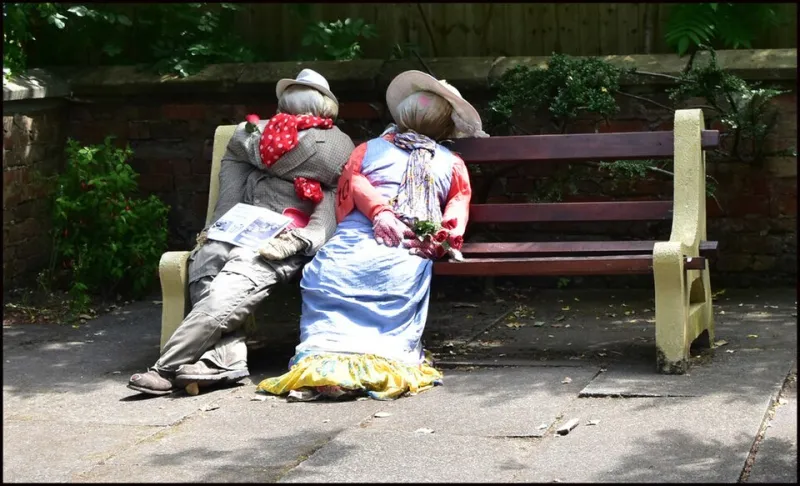
Photo: Norman Caesar, CC BY-SA 2.0, via Wikimedia Commons
Every autumn, somewhere between the harvest festival and the first truly aggressive leaf blower, a village hall noticeboard sprouts a hand-drawn map. It shows a route past the church, the pub, the primary school and a hedge that has never fully recovered from 2019. The map is for a scarecrow trail. The prize is usually nothing more than a rosette and the warm glow of having out-strawed your neighbours. The real exhibition is the village itself.
These trails are not quaint leftovers. They are temporary, slightly unhinged outdoor galleries, curated by people who know exactly how to make a broom look like a retired headmaster. You arrive for a pleasant stroll and leave having photographed a straw Boris Johnson, a straw vicar and a straw pensioner apparently waiting for a bus that stopped running in 2017. It is folk art with a zip tie.
The Broom Gets a Blazer
A scarecrow, at its most honest, is a wooden cross, a bundle of straw and a shirt that was once somebody’s sensible late uncle. The village trail version adds ambition. Suddenly the broom has a waistcoat. The broom has a name badge. The broom is holding a plastic pint and looking at you as if you owe it money.
This is where the British genius for dressing up meets the British genius for not throwing things away. Old curtains become capes. A cycling helmet becomes a head. A pair of gardening gloves becomes hands that have seen things. The results are sometimes magnificent, sometimes unsettling, and occasionally both: a scarecrow so convincingly lifelike that you apologise to it before realising it is made from a mop and a football.
A Trail Is a Temporary Exhibition
The map is the catalogue. The village is the gallery. The route takes you past tableaux that range from the sweetly domestic to the frankly political. One garden has a straw family having a picnic. Another has a straw astronaut stranded by the duck pond. A third has a straw farmer holding a sign that says, in impeccable marker pen, that the post office opening hours are a disgrace.
What makes a good trail is not technical skill. It is commitment. The best entries understand that a scarecrow works best when it has a job. The scarecrow at the pub should look like it is about to complain about the beer. The scarecrow at the school should look faintly alarmed by the prospect of Ofsted. The scarecrow outside the church should look as though it has been asked to do the flowers and has opinions about chrysanthemums.
Field Notes from the Straw Aisle
There are archetypes. The pub landlord scarecrow, usually in an apron, often holding a real empty glass, always the most photographed. The vicar scarecrow, identifiable by a dog collar and an expression of patient endurance. The school crossing patrol scarecrow, which has no need of a lollipop stick because the uniform does all the work. The postmistress scarecrow, which is just a cardigan, a parcel and a look of righteous efficiency.
Then there is the wildcard: the scarecrow that is clearly a film character, a pop star or a local councillor. You know it is meant to be somebody famous because there is a laminated label at its feet. Without the label it looks like a bin bag in a wig. With the label it becomes a bold act of community satire.
The rain is part of the medium. By the second week, straw has sagged. Hats have slumped. A scarecrow that began as Mary Poppins now resembles a disappointed scarecrow who has been left in charge of the village fete and found the tombola unaccounted for. This is not failure. It is the natural ageing of an artwork made from weather and optimism.
How to Shoot a Scarecrow Without Losing Dignity
Photographing a scarecrow is a negotiation between you and a object that cannot give consent but will absolutely judge your composition. Get low. A scarecrow photographed from standing height looks like a coat on a stick. A scarecrow photographed from knee height looks like a character with a past. Include the context: the garden gate, the pub sign, the wheelie bin. The bin is often the most honest supporting actor in the frame.
Overcast light is your friend. Britain in autumn provides a soft box the size of a county. Avoid harsh flash unless you want the scarecrow to look like a suspect in a rural crime drama. Use a longer lens if you can, so you can isolate the absurd details: the plastic grapes, the single Wellington boot, the wig made from a shredded mop. And please do not rearrange anybody’s scarecrow for a better shot. It has been through enough.
The Afterlife of Straw
By November, the trails come down. The maps go back in the village hall drawer. The straw goes on the compost. The waistcoat returns to the wardrobe, slightly damp and smelling of ambition. For a few weeks, though, the village was a gallery with no admission charge, no gift shop and no invigilator telling you not to touch the art.
That is the charm of the scarecrow trail. It is proudly temporary, proudly homemade and proudly local. It asks nothing of you except that you walk slowly, look closely and resist the urge to straighten a stranger’s hat. Owl’s Pics approves. Any exhibition where the star exhibit is a broom in a blazer deserves a private view, a catalogue and at least one photograph taken from a respectful knee.