Six-Legged CCTV: What Britain’s Security Lamps Reveal After Midnight
It starts with a click. At 9.47pm, a security lamp above a pebble-dashed garage in a cul-de-sac somewhere near Stockport snaps on because a fox has wandered past. The fox keeps going. The lamp, however, has just opened its doors.
Within seconds, the light is doing what lights do in Britain after dark: it is pulling in a cast of thousands. A hawk-moth the size of a folded bus ticket arrives first, then a cloud of smaller somethings that look like animated punctuation. A daddy longlegs careers in sideways, all knees and no apparent plan. The show has begun, and nobody booked a ticket.
This is the strange, free, slightly moth-eaten nightclub at the edge of the British home — and for a photographer, it is one of the best small stages in the country.
The accidental velvet rope
Porch lights are not designed to be entertainment. They are designed to stop people tripping over the recycling box. But give a suburban security lamp a warm evening, a modest garden and a nearby hedge, and it becomes an insect version of the O2: no guest list, no dress code, just lumens and a certain willingness to make a night of it.
Homeowners know. Elaine in Worthing has a moth scorecard on her fridge, updated with a biro and an air of quiet competitiveness. Dev in Leicester calls his back-door lamp ‘the main stage’ and has been known to adjust its angle before guests arrive. A couple in Northumberland once admitted they had stopped using their front door after dark because the light had become ‘too busy’ — and they did not entirely mean it as a complaint.
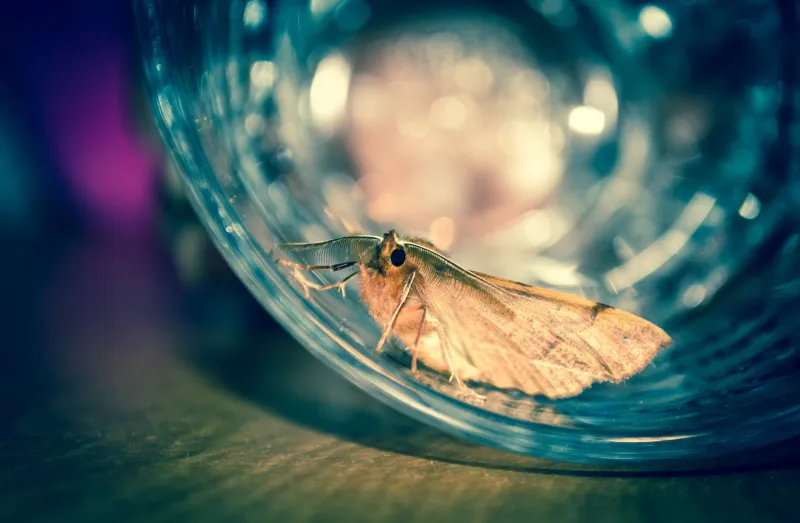
What makes it photographically interesting is the scale. A car park at midnight gives you sodium vapour and loneliness; a porch light gives you a close-up. You can stand on a kitchen stool, lean over a wheelie bin and photograph creatures that look like they have been designed by a committee of jewellery makers. It is macro work with a cup of tea waiting indoors.
A field guide to the committed
Not every visitor is a headline act. After a few nights of lamp-watching, you start to recognise the regulars.
The hawk-moth. The fighter jet of the porch scene: streamlined, faintly absurd and prone to arriving with a noise like a small helicopter. Photograph it side-on and it looks like it should be on a banknote.
The silver Y. A migrant with a tiny white marking on its wing that looks like a badly drawn letter Y. It turns up with the energy of someone who has just got off a coach from the coast and is determined to have a good time regardless.
The caddisfly. Damp, understated, often found near water and apparently dressed for a different event entirely. In a macro shot, it has the slightly weary look of a wedding guest who has been standing in the car park for an hour.
The daddy longlegs. All legs, no centre of gravity. It does not so much land as arrive in installments. Its portrait is best taken with a wide lens and a forgiving attitude.
The pug. A small moth with a name that suggests a disappointed dog. It is not disappointed. It is just very small and very committed to the lamp.
And then there are the supporting acts: midges in a loose haze, a late wasp wondering whether it has made a terrible mistake, and the occasional spider that has realised the lamp is not a nightclub but a buffet with a lighting rig.
How we shot it
You do not need a studio. You need a white sheet, four clothes pegs, a torch, a step stool and a camera with a macro setting — or a phone, a steady hand and a certain willingness to look odd to the neighbours.
Peg the sheet to a washing line or a fence near the lamp. Turn the main light off between shots and use a small torch to focus. Keep the flash gentle; these are tiny creatures, not defendants in a courtroom. Work slowly, avoid spraying anything, and leave the lamp on long enough for the insects to settle but not so long that you become the person who has turned a security light into a hobby.
A word of caution: the first time you do this, someone will assume you are either burgling the house or surveying it for the council. A friendly wave and a visible mug of tea usually resolves matters. One photographer we know was asked by a neighbour if she was ‘doing the moths’ and, when she said yes, was immediately invited to come and do theirs.
The neighbours have views
Porch-light photography is a social activity whether you plan it or not. Net curtains twitch. A man in a dressing gown asks if you have found anything good. Someone’s auntie brings out a plate of biscuits because it is cold and you are standing in a hedge. The lamp itself becomes a talking point: too bright, too orange, too low, too expensive to run. Britain can have an argument about anything, and a security light is no exception.
But there is also a quiet pleasure in it. People who would never call themselves naturalists will tell you about the big moth they saw last Tuesday. Children become experts in five minutes. The doorstep, briefly, is a place of spectacle.
The small print of the light
We are not here to deliver a lecture on light pollution, partly because the moths have heard it all before and partly because the subject is more complicated than a porch bulb. But it is worth saying: the show is not entirely free. Insects are drawn to artificial light, and not every visit ends well for them. Keep the lamp on for the duration of the shoot, not all night. Point it down. Use a warm bulb if you can. And if you are going to run a nightclub for insects, at least be a considerate promoter.
The last act
By 11pm, the cast has thinned. A few die-hards remain on the wall: a pug, a caddisfly and something too small to identify without a microscope and a better attitude. The lamp clicks off. The fox, if it is still around, has the cul-de-sac to itself again.
Photographing porch lights is not glamorous. It involves bins, pegs, cold hands and the nagging feeling that a neighbour is watching you through a gap in the curtains. But it is also the most accessible wildlife photography in Britain: no permit, no hide, no 4am drive to a reedbed. Just a light, a wall and a cast of tiny creatures who did not know they were the show.
The moth does not know it is a metaphor. It just knows the light is on. And on a damp Tuesday in November, that is enough for both of us.