The Woolly Wait: Britain's Bus Shelters Have Become Tiny Galleries
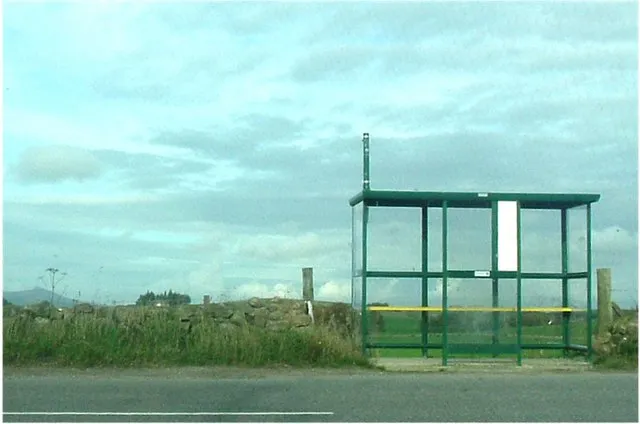
Photo: Stanley Howe, CC BY-SA 2.0, via Wikimedia Commons
The bus shelter on the edge of a village somewhere between Skipton and Kirkby Lonsdale has a laminated sign, a bench, a timetable that appears to be decorative, and a knitted crown on the litter bin. I am here because a friend said, 'You like weird Britain. Go and look at the bus stop.' She was right.
A Shelter With a Curatorial Vision
This is not a bus shelter. It is a small, weatherproof gallery with a bus problem. On the noticeboard there are felted robins, a hand-drawn map of the village, a poster for a jumble sale ('No early birds, please, we are not made of sausage rolls') and four children's drawings of buses. The buses in the drawings have eyelashes. One has a name: Brian.
The display changes with the seasons. In October it was harvest festival: knitted carrots, a laminated poem about apples, a jar of jam with a raffle ticket. In December it will be a nativity, apparently with a knitted donkey that has been 'in progress since 2019'. The whole thing is curated with the seriousness of a Tate show and the budget of a church bring-and-buy.
The Anonymous Makers
The makers are not hard to find, but they are hard to pin down. 'We don't do it for credit,' says a woman I'll call Elaine, unpicking a wonky star from a scarf. 'We do it because the 7.42 is bleak and the shelter has a leak.' She is part of a loose network of knitters, yarn bombers and general busybodies who have decided that waiting for public transport should be a bit less grim.
No one admits to starting it. That is how you know it is genuine folk art. The postbox topper craze has been spreading across Britain for years, but the bus shelter is its natural habitat: a captive audience, a roof, and a bench that encourages contemplation. The parish council tolerates it. The only rules, Elaine says, are 'nothing political, nothing rude, and nothing that will frighten a dog.'
Why Bus Shelters?
Because waiting is boring. Because rural buses are rarer than dry days in February. Because a bus shelter is the last free exhibition space in Britain that does not require a funding application. You can put up a poem, a drawing, a tiny library or a knitted fox in a high-vis jacket, and the only gatekeeper is the weather.
There is also something quietly democratic about it. The audience is not self-selecting. It is whoever is going to the doctor, the school, the shop or the pub. They did not come for art. They came for the 10.14. And now they are looking at a felted robin and feeling slightly better about the fact that the 10.14 is late.
A Field Guide to the Rural Bus Shelter Gallery
Look for seasonal yarn, laminated poems, a jar of flowers, a QR code to a church service, a tiny book swap and at least one notice written in handwriting that suggests the author has strong opinions about parking. The best shelters have a theme and a rota. The very best have a small plastic tub for donations, which is empty, because it is Britain.
If you see a knitted postbox topper nearby, follow it. It is probably part of the same unofficial trail. If you see a child's drawing of a bus with eyelashes, do not adjust your camera. You are in the right place.
On the way home I missed two buses. I regret nothing. The bus may not come, but the art definitely will.