Clip Show: Britain's Topiary Gardens Are Living Sculpture With Attitude
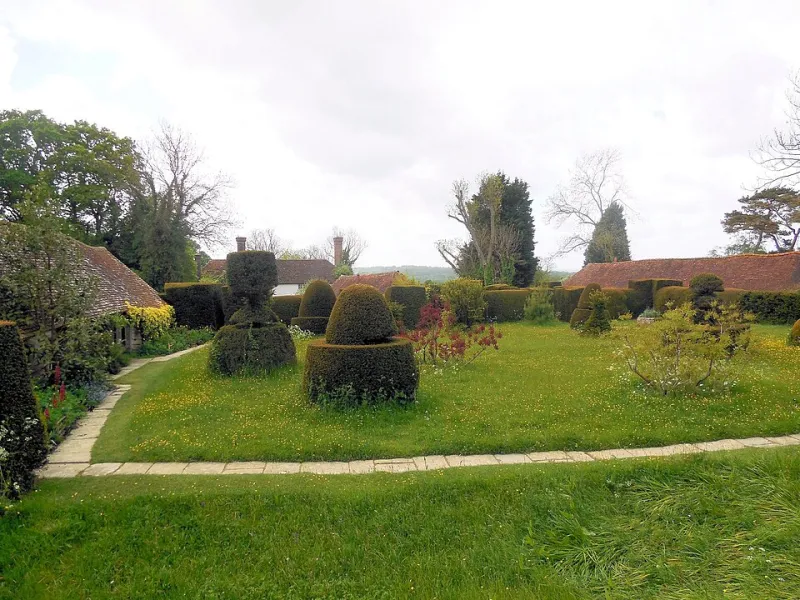
Photo: Paul Gillett , CC BY-SA 2.0, via Wikimedia Commons
Topiary is what happens when a gardener looks at a hedge and thinks: that could be a teapot. It is also what happens when a gardener has a lot of time, a sharp pair of shears and a family who have learned not to ask questions. Across Britain, in private gardens, village greens and the edges of country estates, ordinary hedges are being turned into dinosaurs, spirals, peacocks, armchairs and at least one extremely suspicious cat. It is living sculpture, and it is gloriously eccentric.
At Owl's Pics, we have been photographing these green characters for a new photo essay. The brief was simple: find the most theatrical topiary in the UK, meet the people who clip it, and work out how to make a hedge look like it is about to say something. The answer, as ever, is patience. And a ladder.
The Slowest Show in Britain
Topiary is not a quick art form. A decent spiral takes years. A recognisable teapot can take five. A dinosaur — depending on the species and the gardener's optimism — can take a decade. This is not gardening as instant gratification; it is gardening as long-form improvisation. The gardener plants, waits, clips, waits, squints, clips again, and eventually produces something that looks like a green bear wearing a hat. Or a green bear that has been told the hat is not happening.
The results are worth the wait. Topiary has a way of making a garden feel like a stage set. A row of clipped peacocks beside a gate is not just landscaping; it is a greeting. A huge dinosaur looming over a privet hedge is not just a hedge; it is a local landmark. And a teapot made of yew is, frankly, a conversation starter.
The Cast: Dinosaurs, Teapots and a Cat Called Susan
We met gardeners who had spent decades shaping their hedges into personal jokes. One man in Worcestershire had clipped a tea set — pot, cup, saucer — because his wife had always wanted a tea shop and he had always wanted an excuse to buy a taller ladder. A woman in Fife had created a row of topiary chickens, then added a fox, then spent the next three years making sure the fox did not look too pleased with itself. In a village in Somerset, a gardener had shaped a large yew into what he described as 'a cat called Susan'. Susan has ears, a tail and an expression that suggests she has just remembered something important. She is magnificent.
These are not grand formal gardens with signs and ticket desks. They are personal projects, often visible from the pavement, often maintained with a pair of shears and a strong opinion. The gardeners are usually happy to talk, provided you do not stand on the flowerbed or suggest that the dinosaur might be a bit much. It is not a bit much. It is exactly enough.
How to Photograph a Hedge Without It Looking Like a Bush
Topiary photography has one big enemy: flat British light. The good news is that flat light is also your friend. Overcast skies act like a giant softbox, softening shadows and revealing the texture of clipped leaves. Shoot on a grey day, or wait for a cloud to pass over the sun, and you will get a cleaner, more sculptural image than you would in harsh midday sun.
Here is what works for us:
- Shoot after rain. Wet foliage has more contrast and a lovely deep green tone. It also makes the sculpture look alive rather than dusty.
- Use a polarising filter. It cuts glare on glossy leaves and deepens the sky if you are shooting wide. Do not overdo it; you still want the hedge to look like a hedge.
- Stop down. Topiary is about shape, so use f/8 or f/11 to keep the whole sculpture sharp. If you want a shallow depth of field, focus on the eyes — yes, even if the eyes are made of yew.
- Include scale. A dinosaur is only impressive if we know how big it is. Put a gardener, a ladder, a gate or a dog in the frame. The dog is optional but usually helpful.
- Shoot the details. Clipped edges, tiny new shoots, the flat planes where the shears have been. These close-ups are the fingerprints of the gardener.
- Try winter. Evergreen topiary holds its shape in winter, and the low light gives it a beautiful, slightly eerie quality. Snow is a bonus.
The Patience Ledger
Every topiary gardener we met had a version of the same story: a shape that got away. A peacock that turned into a mushroom. A rabbit that looked more like a handbag. A spiral that, after a decade, was described by a neighbour as 'a nice big green screw'. These failures are part of the charm. Topiary is a negotiation between the gardener's imagination and the plant's willingness to cooperate. The plant usually wins, but the gardener keeps clipping.
That is the real subject of these photographs: not just the finished shape, but the years of attention behind it. A teapot hedge is funny. A teapot hedge that took five years, two ladders and a lot of stubbornness is funny and rather moving.
A Field Guide to Eccentric Topiary
The Spiral. The beginner's topiary. Elegant, achievable, and still impressive when viewed from the road. Photograph it against a plain wall or sky.
The Dinosaur. The show-off. Often a private garden creation, usually visible over a fence. Approach with respect and a long lens.
The Teapot. The domestic surrealist's choice. Best photographed slightly from below, so it looks like it is about to pour.
The Chicken. A classic of the cottage garden. A row of chickens is better than one chicken, because it looks like a queue.
The Suspicious Cat. Rare. Usually called Susan. Do not ask why it is suspicious. It just is.
The Owl's Pics Verdict
Topiary is Britain at its most patient and its most bonkers. It is also a gift for photographers: sculptural, photogenic and full of personality. Go looking for it in villages, on the edge of town, in gardens open for charity. Ask before you photograph. Compliment the gardener. And if you see a green cat called Susan, tell her we said hello.