It’s Behind You — and Slightly Wonky: The Hand-Painted Kingdoms of Britain’s Village Pantos
There is a particular smell to a village hall in late November. Somewhere between floor polish, cold radiators and the ghost of a hundred teas. Then someone opens the door to the back room, and it hits you properly: emulsion, Pritt Stick and the unmistakable whiff of a fairy liquid bottle being converted, against its will, into a magic lamp.
This is where Britain’s amateur pantomimes are assembled — not in the West End, but on folding tables next to a stack of spare chairs, by people who have day jobs and a firm belief that a castle can absolutely be made from three fridge boxes and a pot of tester paint. As a photo story, it is almost unfairly generous.
The Castle That Leans Like a Friday Night
Find me a village panto backdrop that is entirely straight and I will show you a backdrop that has never been in a village hall. The great hand-painted castles of amateur panto are works of unforced expressionism: crenellations that sag gently to the left, towers that taper with the confidence of a cheese straw, a portcullis that is clearly a vegetable rack with some gold spray on it.
And that, frankly, is the point. Nobody is aiming for the Alhambra. They are aiming for recognisably a castle, by 7.30pm on opening night, on a budget funded by a raffle and the generosity of a man called Keith who knows a man with a van.
Photographically, these are dream subjects. Shoot them flat on, dead centre, as though they were Turner prizes hanging in the Tate. The formal framing does the comedy for you: the dignity of the composition against a beanstalk constructed from pipe insulation and green crepe paper. No caption needed. Slight tilt, honest light, done.
Props of Dubious Provenance
Every panto has a props table, and the props table is the single greatest still-life subject in British amateur theatre. On it: a wooden spoon painted silver, a plastic crown with a hairline crack, one (1) illuminated pumpkin with a bulb that flickers, and a goose. The goose is always papier-mâché. The goose is always watching you.
Ask politely before you photograph, and ask again before you touch. Props are surprisingly fragile, occasionally borrowed, and once — in a hall somewhere near Devizes — famously still in use as a serving dish at the interval. Photograph them from above, on the table, under whatever light is available. The clutter is the story. Don’t tidy it.
Glitter-Dusted Dressing Rooms
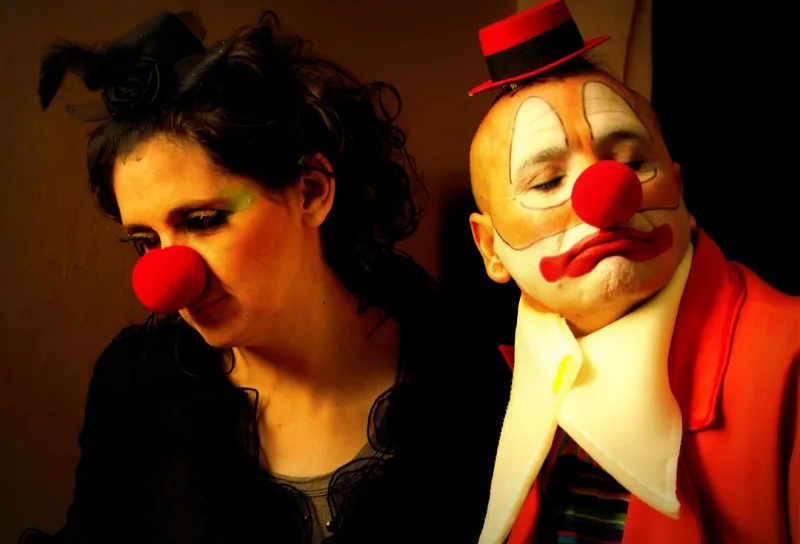
Halls don’t have dressing rooms so much as rooms with a mirror propped against a piano. That is fine, because the mirror is where the real documentary happens: a Dame applying eyeliner in a coat that cost more than the set, a principal boy in full spangle checking their phone, a stage manager muttering into a headset fashioned from a pair of old headphones and hope.
Use available light. No flash in a small room, ever. Shoot into the mirror, over the shoulder, at waist height — the frame that catches both the painted face and the ordinary world behind it (a tea urn, a laminated fire notice, someone’s anorak on a hook). That contrast is the entire article in one picture.
Cardboard Never Looked So Good
Here is the quiet joy of it: amateur panto is Britain’s most enthusiastically improvised folk art. A flying carpet is a rug stapled to two broom handles. A beanstalk is whatever the local hardware shop had left. A coach is a wheelbarrow with a cushion in it. Nobody is being ironic. Nobody is winking. It is made with total sincerity, at speed, by people who are quite tired and very invested.
That sincerity photographs beautifully. Sit with a set for five minutes and you start to notice things: a pencilled measurement someone forgot to rub out, a stray thumbprint in the gold paint, a repair job along the bottom of a flat where it has been kicked in every December since the panto moved to the new hall. Photograph those details. They are the fingerprints.
Get In Before the Audience Does
Our advice, if you fancy a wander with a camera this season: go to the get-in. That is the day the flats go up and the world’s least graceful flying rig is tested. Turn up early, offer to carry something, and shoot the chaos before it becomes a set. Mid-afternoon light through high hall windows, people in coats arguing about a ladder, a backdrop leaning against a wall waiting for its moment — that is the shot.
And then, if you can, come back for the show itself. Photograph from the back of the hall, in the dark, at the moment the audience is shouting “it’s behind you” with real fury at a man in a wig. You won’t get a clean image. You’ll get something better: a roomful of people, all ages, entirely delighted by something that did not exist a fortnight ago and cost about £180.
Oh Yes It Is
There is a school of thought — usually found in people who have never been in one — that amateur pantomimes are charmingly rubbish. Wrong. They are a whole village’s worth of drawing, painting, sawing, sewing and rehearsing, aimed squarely at making a hall full of children gasp. That is not a lesser art. That is just art with a smaller budget and a better raffle.
So this December, take the camera to the village hall. Point it at the wonky castle. Photograph the goose. Somewhere on the front row, a six-year-old is going to remember it for the rest of their life — and now, so will you.