Sodium City: Why Britain's Empty Car Parks Are Our Best Free Film Sets
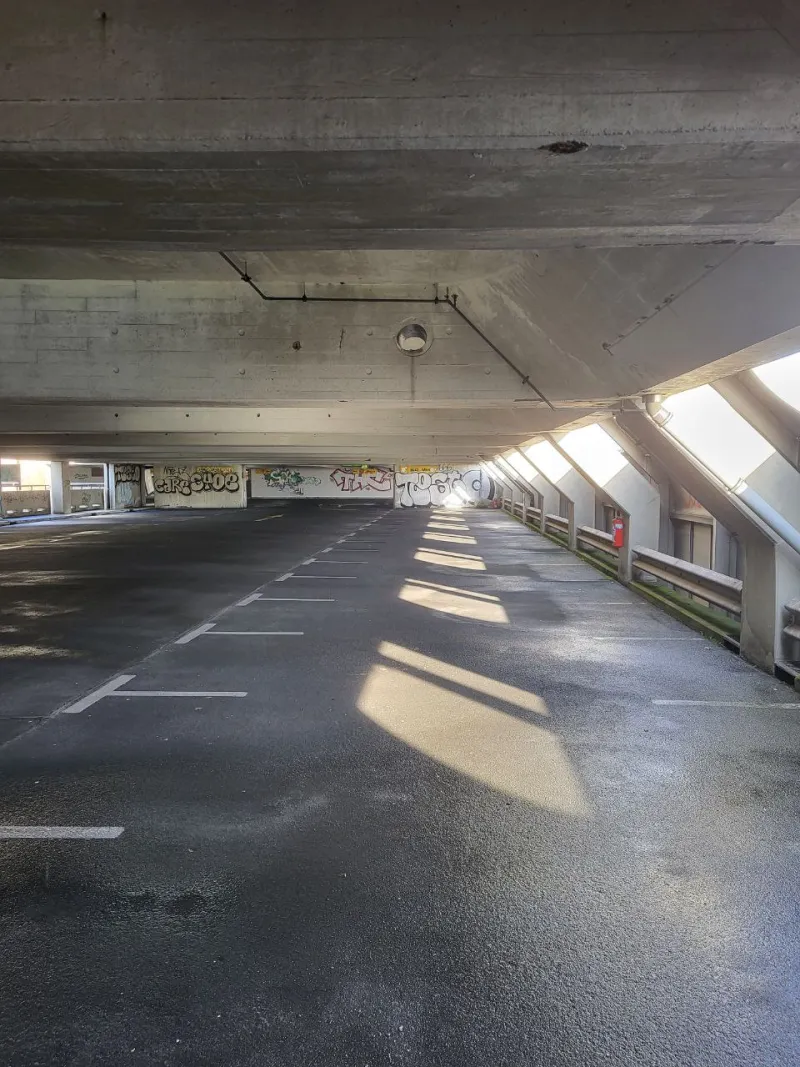
Photo: SeargeantSnack, CC BY-SA 4.0, via Wikimedia Commons
There is a particular hour, somewhere between the last bus and the first gull, when a British multi-storey car park stops being a car park and becomes a film set nobody booked. The ticket machine hums. A fluorescent tube stutters overhead like it is clearing its throat. Somewhere on level four a puddle holds an entire city upside down, and nobody is there to see it except you and a fox.
We have spent a lot of evenings in these places. Not because we are film-makers with a budget for a proper studio, but because Britain is full of free, civic, faintly ridiculous architecture that looks extraordinary after dark. The multi-storey is the most underrated of the lot.
The accidental architecture of the ramp
Post-war councils built these structures with a confidence that now reads as pure theatre. Spiral ramps. Exposed aggregate. Stairwells painted a colour that only truly exists under sodium light — a sort of radioactive peach that no swatch book has ever dared to reproduce. Add twenty years of weathering, a few wonky bollards and a sign saying LEVEL 5 NO THROUGH ROAD, and you have a set designer's dream with a two-hour free period.
Crucially, they were designed to be legible at speed: big arrows, huge numerals, chunky lettering. That means they read beautifully in a photograph, even when the only thing in frame is a wet ramp curving off into the dark like a helter-skelter for cars.
Concrete is the most forgiving subject in photography
Here is the technical good news. Concrete at night is a gift. It is tonal, not colourful — which means it soaks up whatever strange light you throw at it and holds a huge amount of detail in the mid-greys. You can underexpose a stop and it simply looks moody rather than broken.
A few habits that have served us well:
- Go wide, then go tighter. A 24mm makes the ramps look endless; a 50mm turns a fire hose reel and a painted arrow into abstract art.
- Chase the tube, not the sun. Mixed lighting is the whole point. Sodium oranges against LED whites against a single surviving green emergency light is a palette you could not order if you tried.
- Reflections are free props. Damp tarmac, a puddle, a polished lift door. Anything wet doubles your composition.
- Keep the tripod low. Concrete ceilings are dull. Concrete floors doing reflections are not.
The gallery we keep going back to
Five frames we end up shooting again and again, in car parks whose names we have politely withheld so they stay quiet:
- The spiral descent. Shot from the top of the ramp looking down, so the white chevrons repeat into nothing.
- The stairwell with the dying light. One tube flickering on a two-second exposure gives you a soft, sour green glow that looks like a 1970s public information film.
- The pay-and-display shrine. Illuminated from within, alone in a vast empty deck, glowing like a small UNESCO site of bureaucracy.
- The top-deck sea view. Coastal towns do this best — a wind-battered deck with a fingerpost, a bin and the entire North Sea doing its thing in the background.
- The mirror puddle. Level two, after rain, with one lonely hatchback reflected in it. Instant album cover.
Making your own mist machine
Britain supplies the fog for free, which feels like cheating. Cold, damp nights between October and March are ideal — the sort of evening when your breath hangs about and the streetlights have halos. Coastal decks get sea fret. Valley towns get proper fog. If you want drama, go out when the Met Office is being unenthusiastic.
If the air is stubbornly clear, a cheap trick: shoot into the light source. Put a lamp behind your subject and let the flare and glow do the heavy lifting. And resist the urge to correct every colour cast. Half the charm of these pictures is that they look like they were taken by someone who had no idea what white balance was and simply got lucky.
Etiquette, or how not to get moved on
A car park at 11pm is not an obvious photography location to a security guard, and we are sympathetic to that. Announce yourself. Phone the operator during the day if it is a big site. Park legally and pay if you are staying past the free period. Never photograph number plates or anybody's face without asking. If a warden asks what you are doing, show them the back of the camera — nine times out of ten the reaction is a shrug and a surprisingly good suggestion about which level has the best view.
Also: check the closing time. Plenty of decks lock their barriers overnight, and there are few photographic experiences more humbling than explaining to a dawn shift why you are still on level six.
Why we keep coming back
These structures are disliked, and we understand why. They are draughty, they smell faintly of exhaust and chips, and in a decade or two many will have been demolished for flats with better lighting and worse atmosphere. But that is precisely the argument for photographing them now. They are free, they are everywhere, and they offer something money can rarely buy: an empty stage with the lights already on.
Take a tripod. Take a coat. Take a pound coin for the barrier, if it still takes coins. And take a moment on the top deck, because the view over a sleeping British town from a concrete shelf is one of the great free attractions of the lot.