Swing Shift: The Front-Garden Gates Turning Britain’s Pavements into a Night at the Theatre
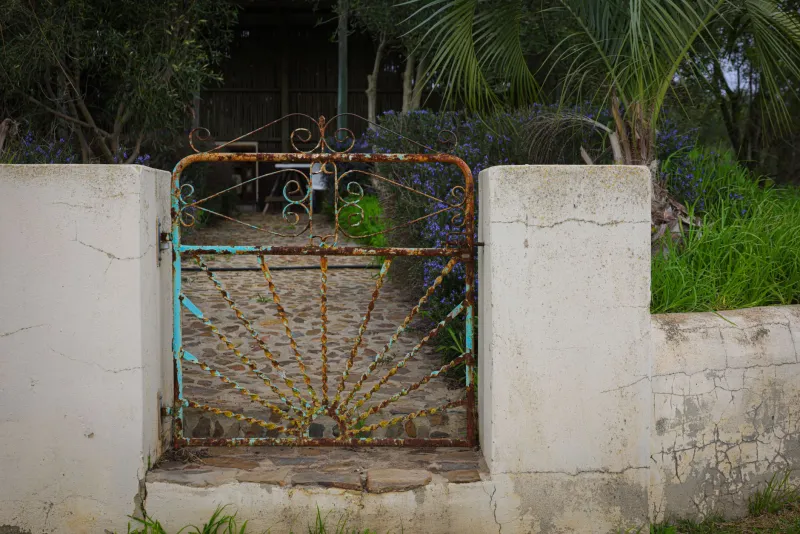
Somewhere between the pavement and the front door, Britain runs a tiny theatre district. There are no West End prices, no interval ice cream and absolutely no dress code. The stages are garden gates: wrought-iron peacocks, painted plywood dragons, homemade trellis arches, and one memorable Norfolk gate that appears to be held together by hope, rust and a bicycle chain.
At Owl’s Pics, we like a picture story that begins with something ordinary and ends with a small act of showmanship. Garden gates are perfect for this. They are functional, yes — they keep the bins in and the fox out — but they are also declarations. A gate says: this is where my territory starts, this is who I am, and yes, the hinge is meant to squeak like that.
The threshold as proscenium arch
A front gate is a brilliant piece of accidental staging. Behind it: a garden, a path, maybe a wheelie bin doing a quiet bit of character acting. In front: the audience, otherwise known as anyone walking past with a dog or a bag of shopping. The gate itself is the curtain. It swings open, it swings shut, and for a second the whole street gets a glimpse of somebody else’s world.
Some owners understand this instinctively. They paint the gate a colour that has no business being next to pebbledash — electric blue, butter yellow, a purple that looks like a bruise with ambition — and then add a house number in letters large enough to be read from orbit. Others go full theatrical: an arch, a lantern, a bit of trellis, and a sign warning couriers that the bell is broken but the dog is not.
We photographed one gate in Yorkshire that had been fitted with a small brass letterbox at eye level, despite the fact that the front door was roughly four feet away. Why? Because the owner wanted the postman to have a moment. That is not practicality. That is stagecraft.
Peacocks, dragons and hardware with ideas above its station
Wrought-iron animals are a recurring theme. Peacocks are popular, possibly because they look magnificent even when they are doing nothing, which is the dream for any garden ornament. We have seen pheasants, herons, a squirrel with a slightly threatening expression, and one metal cockerel that seemed to be guarding a single lavender bush with the intensity of a border checkpoint.
Then there is the plywood school of gate design. A painted dragon curled around a latch. A mermaid on a seaside gate in Kent, her tail disappearing into a swirl of blue paint. A sunflower cut from timber and screwed to a frame with more enthusiasm than accuracy. These are not expensive commissions. They are folk art with a hinge, and they are all the better for it.
One of our favourite finds was a gate in a suburban cul-de-sac with a hand-painted sign reading “Beware of the Cat”. Beneath it, in smaller letters: “He is not dangerous, he is just very nosy.” That is British boundary humour in miniature. The warning is real, the threat is not, and the whole thing is an invitation to smile without actually entering the property.
Beware of the cat: boundary humour in miniature
Gates are where Britain practises its favourite comic form: polite defiance. A sign that says “No cold callers” is a gate doing stand-up. A laminated note reading “Please close the gate — the tortoise is out” is a whole short film. We have seen “Ring bell for attention, not for fun”, “Delivery drivers: the gate sticks, lift and swear”, and a beautifully blunt “Nothing here is worth stealing, including the gate.”
This is not just whimsy. It is a way of managing the line between public and private without building a wall. The gate stays low enough to chat over, but high enough to make a point. It says: I am friendly, but I am also not running a bus station. The humour softens the boundary and makes it human.
Photographically, these signs are gold. They give a gate a voice, and they often tell you more about the household than any number of hanging baskets. The best ones are slightly wonky, slightly weathered, and absolutely certain of their own joke.
Wonky hinges, proud owners
Not every gate is a masterpiece. Some are leaning. Some have been repaired with wire, string, a plank from a previous gate, or a hinge that appears to have been salvaged from a ship. This is part of the charm. A perfectly aligned gate is a nice bit of joinery. A gate that closes only if you lift it slightly and say “come on, then” is a relationship.
We like the homemade hinges best. They are tiny acts of optimism. Someone stood in a shed, looked at a bit of timber and thought: yes, I can make that work. The result may not be square, but it is sincere. And when the gate swings open with a theatrical creak, you can almost hear the audience settle in.
How to photograph a gate without looking suspicious
Our advice: be quick, be obvious and do not lurk. A photographer crouching behind a hedge with a long lens is not capturing folk art; they are starring in a neighbourhood watch newsletter. Stand on the pavement, take the shot, smile at the window curtains, and move on. Early morning is good for soft light and fewer questions. Overcast weather is even better — it flattens the shadows and lets the paint do the talking.
Look for the details that make each gate a character: the latch, the house number, the peeling paint, the sign, the way the path disappears behind a shrub. A gate is a frame within a frame, so use it. Shoot through it, over it, and at an angle that makes the garden beyond feel like a secret set.
The street theatre never closes
Britain’s front-garden gates are not trying to be art. That is precisely why they are. They are practical things with personality, boundary markers with a punchline, and tiny stages where ordinary people rehearse their own bit of showmanship. The curtain is a latch. The audience is a passing dog walker. The review is usually a nod, a smile, or a muttered “that’s nice” — which, in this country, is a five-star rave.
So next time you pass a painted dragon, a metal peacock or a gate held together by optimism and a bicycle chain, give it a second look. It is not just a gate. It is a little act of theatre, and the show is free.