Before the Bin Lorry: A Love Letter to Britain’s Whirring Milk Float Dawn
At 4.47 on a Tuesday in November, the loudest thing in the street is a fridge. Then comes a sound like a giant insect clearing its throat: the milk float, awake and pretending it isn’t. It whirrs past the wheelie bins, pauses by a gate, and leaves behind a small architecture of crates. For about ninety seconds, the road looks like a stage set waiting for actors who never arrive.
This is the quietest parade in Britain. No brass band, no grand marshal, no one live-streaming it. Just a slow electric vehicle, a clinking cargo and a driver who knows which doorstep light means leave two extra and which means the dog is awake, so abandon hope. The milk float is not nostalgic wallpaper. In 2026 it is a working oddity, a stubborn little ritual that survives in pockets of the country and photographs like a dream.
The 4.47 Shift
Milk floats have been doing the pre-dawn shift for generations. The electric float became a familiar sight in the middle of the last century, favoured because it was quiet, clean-ish and cheap to run at walking pace. Long before every delivery app discovered the word logistics, the local dairy had already worked out that the best way to reach a doorstep was slowly, silently and with a crate that rattled just enough to announce itself.
Stand on a pavement in 2026 and the scene is both ordinary and operatic. The sky is the colour of a bruised plum. A street lamp buzzes. Somewhere a boiler fires up like a sulky dragon. Then the float appears, headlights low, bodywork gleaming with condensation, and the whole road seems to hold its breath. You can hear the bottles before you see the vehicle. Clink. Pause. Clink. It is the sound of breakfast arriving by stealth.
A Crate Is a Still Life
Photographing a milk float is mostly an exercise in resisting the urge to shout, Look, it’s a milk float! The vehicle itself is a charming shape — part biscuit tin, part dodgem, part moon buggy — but the real pictures are in the details. A stack of crates on the back. A hand-painted depot name. The driver’s glove on the steering wheel. A single bottle left on a wall, wearing a tiny cap of silver foil like a hat it doesn’t trust.
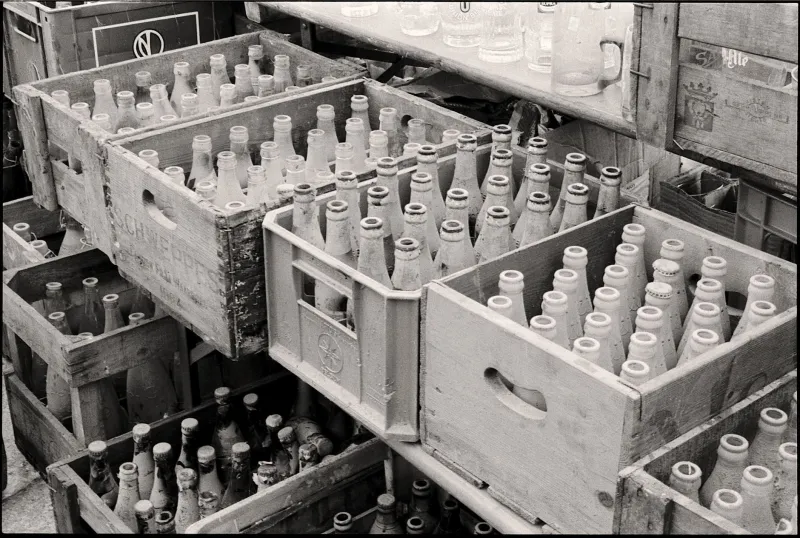
The crates are the unsung heroes. Red, blue, sometimes a faded dairy green, they stack into temporary sculpture wherever the float stops. Shoot them low and close and they become city blocks. Shoot them through a wet windscreen and they turn into a moody abstract. Wait until the driver walks away and the float sits alone under a sodium lamp, and you have a portrait of a vehicle having a quiet moment before the rest of the world wakes up.
Cats, Condensation and the Nearly-Sunrise
Cats are the unofficial inspectors of the milk round. They appear on walls, behind gates and on top of bins, watching the float with the expression of a middle manager who has found a minor breach of procedure. If a cat sits on a doorstep just as the bottle lands, you have won the photographic lottery. If it walks away, you have a blurry tail and a lesson in patience.
Condensation is the other star. On cold mornings, the float’s windows turn into foggy canvases. Headlights bleed into soft halos. Street lamps become smudged moons. A bottle of semi-skimmed catches the light and looks briefly like a tiny lighthouse. This is the hour when ordinary streets become film sets, and the milk float is the only vehicle humble enough to suit the lighting.
Why It Survives — and Why It Photographs
The milk float’s survival is not a fairy tale. Dairy consolidation, supermarket competition and the relentless rise of the oat-milk aisle have all taken their toll. In many towns the daily round is a memory. Where it survives, it survives because it is useful: a local dairy can deliver glass bottles, collect empties, serve the same street for decades and do it all before the first traffic warden has finished their coffee. The float is electric not because it is fashionable, but because it always was. That quietly stubborn practicality is exactly what makes it photogenic.
It also gives a street something increasingly rare: a small, regular, human-scale event. The bin lorry arrives with a roar. The delivery van arrives with a beep. The milk float arrives with a whirr and a clink and a person who knows the names of the dogs. Photographers love rituals that repeat but never look quite the same. The milk float is a daily ritual with weather, cats and condensation built in.
How to Shoot It Without Becoming the Local Menace
Start by asking. A quick word with the depot or the roundsman beats lurking behind a hedge with a long lens and a guilty expression. Explain that you are photographing the float, not the residents, and keep door numbers out of frame. Early morning light is gorgeous, but people’s privacy is not a prop.
Use a fast-ish lens and a sensible ISO. The float is slow, but the light is low. Meter for the highlights if the street lamps are blooming, and don’t be afraid of a little motion blur — a whirring float with a ghost of a driver can look more alive than a pin-sharp parked one. Shoot the crates, the bottles, the wet tarmac, the cat on the wall. Then step back and take the wide shot: float, lamp, terrace, plum-coloured sky. That is the postcard.
Here at Owl’s Pics, we like a picture story that makes you look twice at something you had stopped noticing. The milk float is not glamorous. It is not loud. It does not have a marketing budget. But at 4.47 in the morning, when the street is empty and the sky is doing something expensive, it is the best show in town. Listen for the clink. Bring a coat. And whatever you do, don’t frighten the cat.