Soap Operas: The Neon Hymn of Britain's Last Launderettes
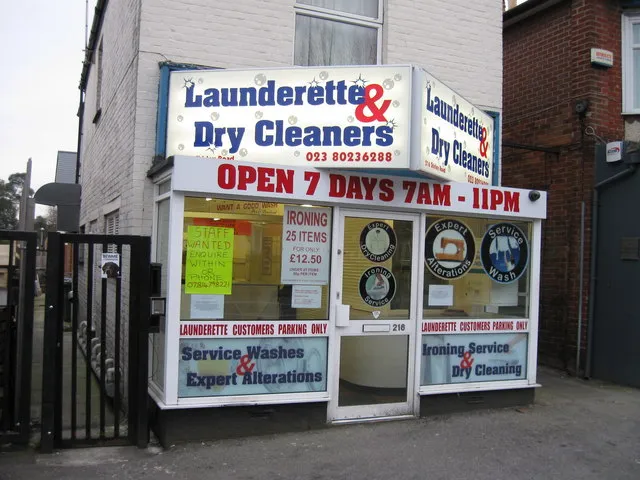
Photo: Alex McGregor, CC BY-SA 2.0, via Wikimedia Commons
You hear a launderette before you see it. Not the machines — the tubes. A low, electric hum that sits under everything, like a fridge with ambitions. Walk past at half seven on a November evening and the window is a warm rectangle of blue-white light in a grey street, with three drum windows turning slowly behind it, and you think, without quite meaning to: someone should photograph that.
So we did. Over the last couple of years we have been collecting Britain's remaining launderettes the way other people collect vinyl, and we have come to a firm conclusion. These places are not sad. They are glorious, and they are going.
The church of the fluorescent tube
There is a specific quality to launderette light that no studio can fake. It is flat, it is relentless, it is slightly green, and because the ceilings are low and the walls are usually tiled in something pale, it bounces around and removes every shadow except the ones that matter. Add a strip of neon in the window — LAUNDERETTE, LAUNDERETTE + DRY CLEANING, sometimes just WASH — and you have the whole package: cold light inside, hot colour outside.
Our favourite signs are the ones that have been repaired rather than replaced. A letter gone dark. A tube that has gone pink with age. The cursive version nobody makes any more, buzzing at a frequency you can feel in your teeth.
Where to find the good stuff
We are not going to pretend this is a definitive list; launderettes open and close with the seasons. But these are the sorts of places worth a detour, and the towns that still carry the look:
- Seaside towns on the Lancashire and Yorkshire coast. Salt air, faded signage and a clientele of holiday lets and static caravans. The light outside is often grey, which makes the window glow twice as loud.
- London's older high streets. The ones under railway arches, or wedged between a barber and a betting shop, still running on a coin slot and a handwritten price list.
- Scottish tenement neighbourhoods. High ceilings, big windows, a row of drums facing the street like a shop display.
- University suburbs anywhere. Guaranteed busy on a Sunday, guaranteed to have a laminated notice about the big machines.
- Market towns with a car park behind the Co-op. Where the launderette is the last lit thing on the parade after 6pm.
The choreography of a Tuesday morning
This is where the pictures really live. A launderette is a small theatre with a fixed cast and a rotating set.
The regulars arrive in a sequence. First the early pair, who clearly know each other and have arranged to overlap. Then the person with the duvet, who always underestimates the machine size. Then the quiet one in the corner with a book, who has perfected the art of sitting at exactly the right angle to the drum so they can watch it turn without appearing to.
And then there is the great unspoken choreography of the machines themselves. Loads are timed so that washing finishes as drying begins. Baskets are parked in a system understood by everyone and written down nowhere. There is a particular satisfaction in the moment a drum slows, thumps, and stops — and the whole room looks up at once, like a congregation at the end of a hymn.
If you are photographing, work quietly and ask first. A launderette is a semi-private space; people are handling their smalls. A simple 'do you mind if I take a picture of the machines?' gets you a yes far more often than a long lens through the window.
The found poetry of the noticeboard
Every launderette has one, and every one is a minor literary event. Biro on lined paper. Taped at an angle. Slightly out of date.
- 'PLEASE DO NOT PUT DOG BEDDING IN THE 8KG.'
- 'Last wash one hour before closing. THIS MEANS YOU.'
- 'Machine 4 is temperamental. Be nice to it.'
- 'No football kits after 5pm.'
- A hand-drawn diagram of how to use the dryer, with an arrow and the word 'COINS' underlined three times.
Photograph these properly. Flat on, filling the frame, no clever angles. They are social history and they will be gone before the machines are.
Shooting the spin
The technical bit, briefly. Drum windows are bright and the room is not, so expose for the glass and let the rest fall away — a slow shutter turns a spinning wash into a smear of colour, a fast one freezes a duvet mid-tumble. A polarising filter kills the reflections on the glass and lets you see inside. Stand outside after dusk and the whole shopfront becomes a lightbox. And please, resist the urge to turn the picture black and white. The colours — that pale tiled green, the orange of an old dryer, the hot pink of a fading sign — are half the reason you stopped.
A last spin
There is a version of this story where launderettes are mourned as relics of a time before everybody had a washer-dryer and a spare hour. That is not our version. We like them because they are warm, bright, cheap, unglamorous buildings that still do exactly what they promise, and because they are among the last public interiors in Britain where strangers sit in a room together and say nothing at all, comfortably.
Go while the tubes are still humming. Take a bag of washing as cover, put a pound in the dryer, and watch a whole street's worth of life rotate behind a porthole. It is the cheapest show in town, and it is on every evening.